top of page

Transformative Technologies for the Developing World, of Clean Water, Clean Indoor Air and Industrialization
Production of Sanitary Stoneware Toilets
- Including the Essentials of Model and Mold Making -
Scroll down, near the end, to see a shortcut to mold making for the toilet

The Urine Diverting Sanitary Stoneware toilet can be produced almost anywhere, given the capacity to fire the eight pieces to 1250C. Stoneware is chosen as opposed to porcelain because the clay material can be readily available. The only real difference between stoneware and porcelain is that stoneware is gray or brown, while porcelain is white. Stoneware and porcelain have the same fracture strength, a requirement of sanitary ceramic ware..
Because the toilet is in eight pieces, these can be put together in much the same way that tiles are, with a grout between them. With a big enough kiln, the eight pieces can be joined together soon after the forming process of the clay, for the toilet to be a single piece.
The capacity to produce the toilet is the very capacity needed for the production of a wide range of products. It starts with training in quick production techniques of duplicates in producing models and molds. For example, glazed, tiles of all kinds can be produced. Such dinnerware as glazed plates, bowls and teapots are made possible, in building and using an inexpensive air-release press. Hygienic surfaces become possible in places where there are no hygienic surfaces. .
Simple electrical insulators can be produced. Many kinds of metal products become possible, using ceramic shell molds. The newly enabled, high temperature processes of ceramics are at the starting point of industrial development. Resource intensive development is made possible, in contrast to capital intensive development.

The models of the feces and urine pans of the sanitary stoneware toilet are made, starting with the setup shown at left. Thickening plaster or another modeling material is applied over the wire screen. A metal straight edge is then skimmed around the surface, applied at the top and the bottom, scraping away the excess material. This gives the model shown at right. Once the plaster or modeling material is firm it can be scraped and sanded, true to form.


The foot rests of the toilet are shown, in the process of model and mold making. At right, in preparation for pouring rubber, wooden slats have been glued to a sheet plastic base. Sheet aluminum is formed around these wooden slats for the outer edges of the piece. The rubber mold is then ready to pour. The resultant rubber master mold is shown at left, in the center of the picture. To the right of the rubber mold is a concrete working mold, cast from it. The concrete mold was used to form the stoneware clay piece of the toilet, to the left of it.
This clay piece is ready for drying, then firing and glaze application. Then it will be glaze fired. Note that concrete is not a typical mold material while the preference is plaster of paris. Concrete is used because it's widely available while plaster is not. A disadvantage of concrete molds is that fewer cast pieces can be produced per day, but otherwise there's no problem.
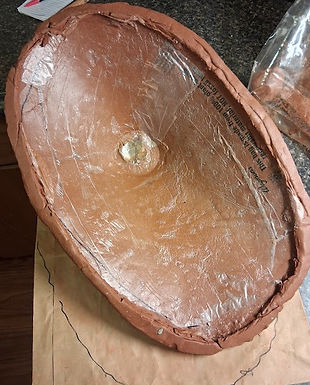
The clay feces pan of the sanitary stoneware toilet is shown at left, the clay having been pressed by hand into its concrete mold. There is a thin sheet, plastic 'release' shown, adhering to the clay. This plastic sheet was cut from a plastic bag. The release material makes possible, easy separation from the concrete mold.
Shown at right are the eight pieces of the toilet in the kiln, ready for firing, having been thoroughly dried. The kiln is about to be fired to 1280C. The firing results in the durability implicit to the high fracture strength necessary to the toilet.

There is a short cut to making the molds for toilet, in the
use of 2-demensional templates, printed on paper. The two
templates shown at right can be cut out, with the periphery
of each traced onto a piece of sheet aluminum. The two
sheet aluminum pieces can then be coiled into 3-dimensional
molds, identical to the concrete molds described above.
Given these sheet aluminum, 3-dimensional molds, it's
possible to form the stoneware clay feces and urine pans,
going on to hand build the other pieces of the toilet.
Achievement of the Capacity to produce toilets can be a pivotal event in the industrialization of a country and its communities. So many new products and services are made possible by training in ceramic processes, including the high temperature processes. An outcome over time is self-sufficiency, freedom from the need for so many imports. Countries that embrace the use of their ceramic raw materials, i.e., rocks and minerals, can achieve industrialization from the grassroots. The cost can be remarkably low, depending primarily on training and education in ceramic arts and engineering.

bottom of page